

USA and Iran Trade Blame For Further Ceasefire Violations
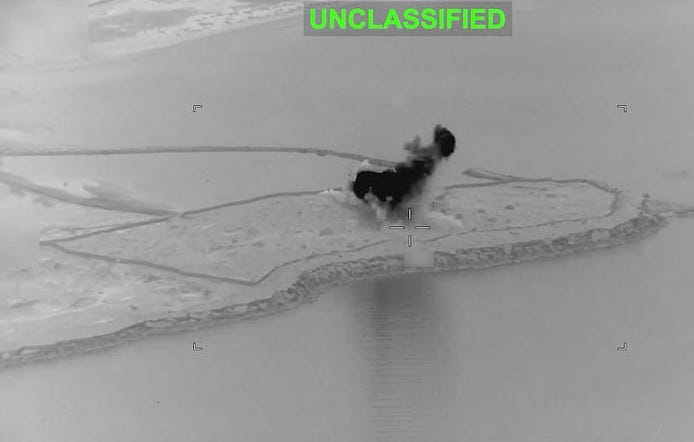
The U.S. military struck Iranian coastal sites in the early hours of Saturday, launching at least three airstrikes, which they have also released footage of. While we can normally ascertain a series of events from these encounters through on the ground OSINT channels, local reporting and official statements, last night’s exchange is a bit of an unusual affair, as there are serious questions around both official explanations.
It is worth noting before examining last night's events that the U.S. naval blockade of Iranian ports, in place since April 13, has itself been characterised by Iran and independent legal analysts as a violation of the ceasefire terms agreed on April 8. The blockade, which has disabled or redirected over 129 vessels attempting to access Iranian ports, is itself a precursor to the events of last night. We acknowledge that the USA’s blockade consistently breaks the ceasefire agreement, the analysis to follow is aimed at the strikes specifically.
After a night of competing claims, all our attempts to verify those claims have come up short, with some key issues that dispute the claims of why last night’s trade of strikes occurred. The USA claims that they had shot down incoming drones, but there are no on the ground reports of drone launches, which we have never failed to identify in previous incidents.
The IRGC, Iran’s military, says four tankers guided by the U.S. military direction attempted to transit at 1:30 a.m., but we cannot find third-party confirmation of the attempted passage. As with the drone launches, the absence is not conclusive, dark sailing is standard practice in this environment, and the U.S. has confirmed it facilitates undisclosed transits.
We cannot confirm the tankers were there any more than we can confirm the drones were launched. We will simply note that the precedent here is that the U.S. has been the entity to break the ceasefire in each documented exchange, a pattern we have covered across the preceding weeks, while they have a documented policy of guiding ships that would theoretically support Iran’s claims. Iran may also have legal grounding in intervention of ships transiting the Strait.
Iran is not a party to the UN Convention on the Law of the Sea (UNCLOS) having signed but never ratified it, meaning the treaty’s “transit passage” provisions, which guarantee unimpeded navigation through international straits, do not formally bind Tehran. Iran’s own domestic Maritime Areas Act asserts that foreign vessels require Iranian consent to transit waters it claims jurisdiction over, providing a legal basis for its interdiction policy that is coherent even if contested.
Most international legal scholars do argue that transit passage rights have hardened into customary international law binding on all states regardless of ratification, but Iran’s position is not frivolous, it has a legal foundation, and it is not up to us or the USA to make a claim on the legal realities, that is for the world’s courts to decide. The USA has not taken to the world courts to get a final decision on passage of the Strait.
What we can confirm is that Iranian ballistic missiles were launched toward Kuwait and Bahrain from Fars and Bushehr provinces. Air defense sirens activated in both countries. CENTCOM claims that six out of seven missiles had been intercepted, which is not a claim we can put weight behind without further evidence. This is due to CENTCOM falsely claiming to intercept all incoming attacks in the previous exchange, multiple strikes had been confirmed, disproving their claim within minutes.
U.S. Central Command’s account, posted to X early on June 6 local time, the first statement from either side. They state that four Iranian one-way attack drones launched toward the Strait of Hormuz and were shot down by U.S. forces. CENTCOM then struck “coastal surveillance radar sites” at Goruk and Qeshm Island in response. The drones, it said, “posed an immediate threat to regional maritime traffic.” Iran then fired the ballistic missiles. CENTCOM released unclassified aerial footage of the Goruk and Qeshm strikes.
Iran’s account, when it came three hours later, challenged the USA’s account. The IRGC said four oil tankers operating under U.S. military direction attempted to transit the Strait without authorization at around 1:30 a.m., ignoring IRGC warnings. One was stopped; the others turned back.
U.S. drones then struck telecommunications facilities on Qeshm Island and at Sirik at around 2:30 a.m. The IRGC’s missile barrage was its response to those strikes. Iran’s Foreign Ministry condemned the U.S. actions as violations of the April 9 ceasefire agreement and of the UN Charter’s prohibition on the use of force, stating the attacks were launched from Kuwait and Bahrain.
CENTCOM makes no mention of tankers, while the IRGC insist tankers are central to the issues overnight. Using open source ship tracking software, we have been able to see a pattern indicating at least one ship may have been turned around overnight, we have identified other ships with movements that grabbed our attention, but did not see conclusive evidence they had been turned around. This does not conclusively prove the Iranian position.
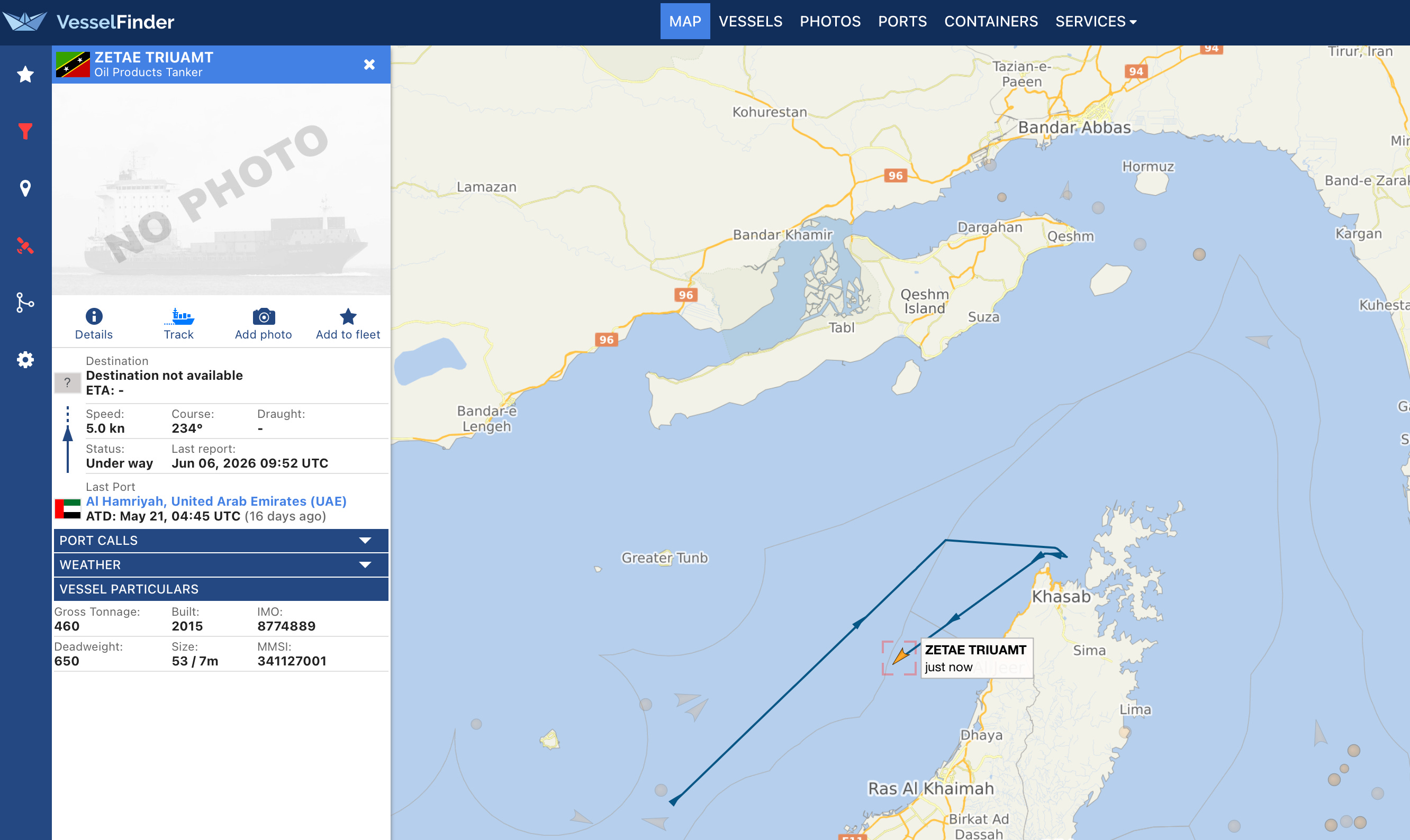
The U.S. has been conducting a documented, quiet escort program for select commercial vessels through the Strait for at least two weeks, described by officials as a limited operation distinct from the paused Project Freedom.
On June 5 itself, hours before the exchange, the U.S. was separately blocking Iraqi oil tankers from crossing the Strait over alleged IRGC toll payments, a claim Baghdad denied. The regime was actively managing tanker movement at the chokepoint throughout that day. Whether four tankers were directed toward the Strait that night with U.S. military backing is unconfirmed. What is notable is that no U.S. statement before or after the incident mentions tankers in the Strait at all, while we know they had been active in the management of tanker passage in that time.
The IRGC claimed its missile strikes damaged the U.S. Fifth Fleet headquarters in Bahrain. CENTCOM denied this, posting a “Fact Check” graphic alongside the denial. No satellite imagery of the Bahrain base from June 5-6 has emerged to resolve it either way. Previously, denied claims by CENTCOM had been disproven through satellite imagery, and while we cannot say that won’t happen now, at the time of writing it has not.
In previous reports, we had been forced to challenge the official U.S. account, as the mountain of evidence presented left us with no other choice. We apply the same skepticism to both sides, and for the first time after a trade of strikes between the two, we cannot confirm either claim.
CENTCOM’s track record during this ceasefire period includes categorical denials later proven wrong by satellite evidence, and a consistent framing of every U.S. strike as purely defensive, even when they are either the sole attacker, or the first to attack.
The IRGC has made damage claims that have not held up. What distinguishes this incident is not which side is less credible, it is that the normal markers by which the information environment can be read are absent. The OSINT channels that have tracked Iranian launch activity throughout this conflict produced no ground reporting preceding CENTCOM’s announcement, in every previous instance, on the ground reports of activity preceded official statements. That, however, is not conclusive.
The tanker question has no AIS footprint, this again is not conclusive, as dark operations are normal in this field. Our own look into open source ship mapping software does indicate at least one ship had turned away, but without further clarification, we cannot hold that up as proof.
We’re hoping we can update this article with more clarity later today, and we will continue watching for updates. However, the inability to prove any of the claims indicates that all claims should be disregarded until proof is supplied. Right now, the only evidence we have points to the U.S. strikes initiating the exchange, all claims predating that remain unfounded.