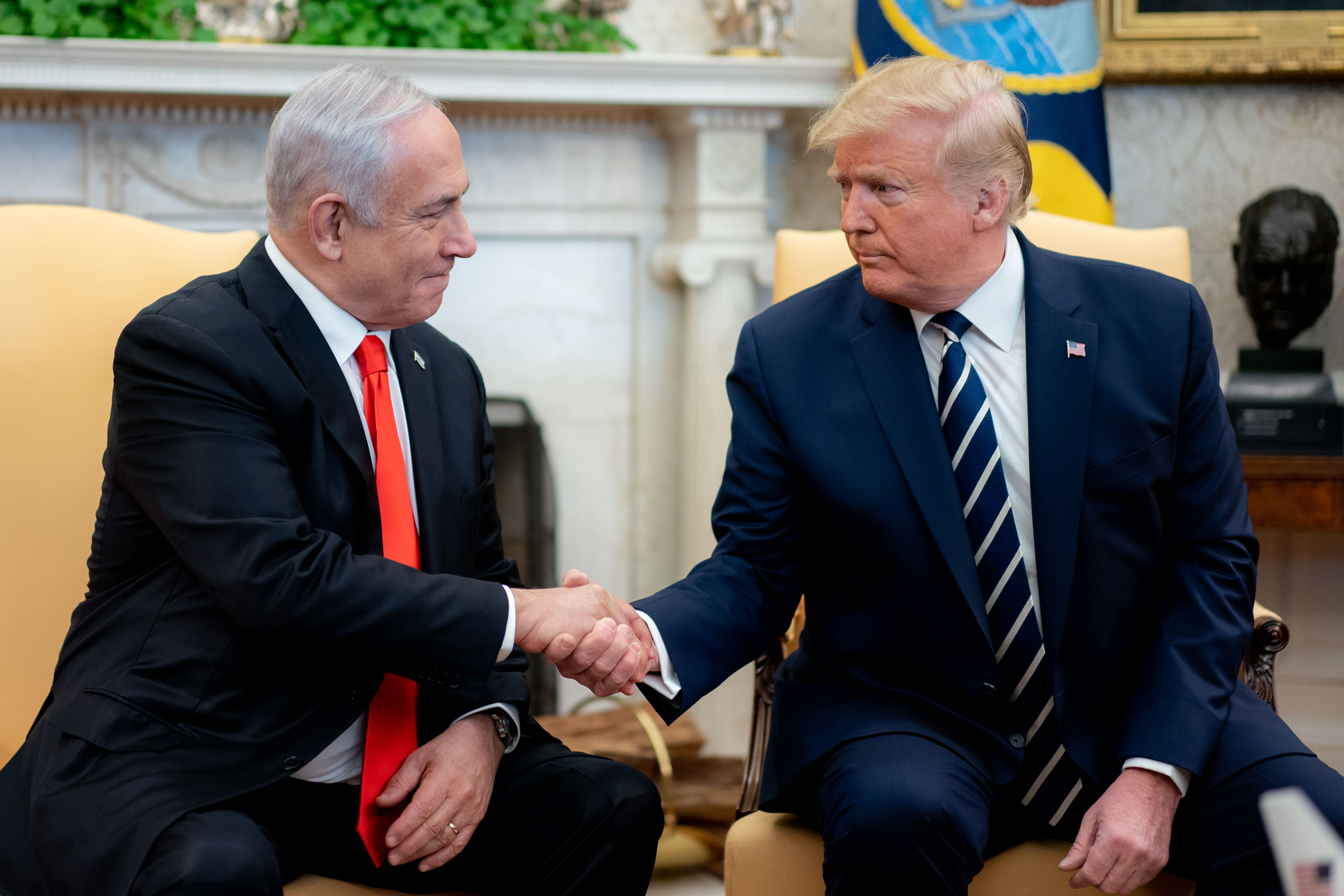
If we are to believe all sides of the negotiations between the USA and Iran, a deal appears to be closer than ever. Both sides of the war, as well at the Pakistani mediators, agree that a deal is imminent. As soon as the language of an incoming deal began to be the default amongst negotiating teams, U.S. President Donald Trump and Israeli officials began undermining the deal publicly.
Donald Trump announced on Saturday that the war with Iran is over. The deal, he wrote on Truth Social, is “scheduled to get signed tomorrow,” after which the Strait of Hormuz will be “OPEN TO ALL.” He claimed it will be the historic opposite of the JCPOA, the successful deal signed by Barack Obama.
Donald Trump claims the deal is a “WALL TO NO NUCLEAR WEAPON,” and claimed Iran “no longer want[s] a Nuclear Weapon, nor will they have one, either through purchase, development, or any other form of procurement.” The JCPOA already was a wall to Iranian nuclear weapons, and there is no evidence the country is building a nuclear weapons program according to the UN’s nuclear watchdog.
Within hours, Iran’s own foreign ministry came out to deny the version of events outlined by the U.S. President, which is all too familiar at this stage of negotiations.
Spokesperson Esmail Baghaei told Iranian state media that the deal “will not happen” on Sunday, though “the possibility that it could take place in the coming days cannot be ruled out.” He added a pointed line: “due to the other side’s inconsistency, we should remain cautious in making any statements about this process.”
It’s clear at this point that this isn’t the first time this has happened. Iranian state media reported, just days earlier, that no preliminary memorandum had been approved at all, after Trump made similarly premature claims of an imminent signing.
Pakistan, the mediator of talks between the countries, would later come out and announce terms had been agreed. Trump simply couldn’t prevent himself from jumping onto social media and announcing an agreement that was in the pipeline, but had not yet been settled.
The nuclear claims don’t hold up either. By Iran’s own account, relayed by Foreign Minister Abbas Araghchi on state television, the initial agreement covers an end to the fighting “on all fronts, including Lebanon” and mutual non-interference commitments.
The actual negotiation over Iran’s nuclear program, the part Trump is describing as already settled, a “WALL TO NO NUCLEAR WEAPON,” is scheduled to take place over the sixty days after signing, with room to extend further. Trump is selling the outcome of a negotiation that, on Tehran’s telling, hasn’t started.
A senior Israeli official, speaking to Ynet on Saturday, actively opposed the deal. “It’s a bad agreement. No one is happy with it. They understand that it’s not good for us and harms Israeli interests.” The official added that what’s “disturbing is that Israel can’t influence and its voice is not heard.”
The official made the insinuation that the deal is not real in substance, claiming it only exists to buy time, “It’s mainly a ‘World Cup agreement, 250th anniversary celebrations for Trump’s 80th birthday.’ The goal is to buy some quiet for all the big events happening in the U.S. right now. Not really something that will hold water.”
And then there’s Lebanon. Iran has been very clear about Lebanon’s position in any upcoming deal, but Israeli officials are already signalling that they will not respect any Lebanon element of a deal.
Araghchi has said repeatedly that the memorandum resolves the conflict “on all fronts, including Lebanon.” Iranian state media’s Mehr news agency, in a draft it published this week, described a permanent halt to the war on every front. Whatever the final text says, Iran is staking its public position on Lebanon being part of the deal.
Responding directly to the leaked draft terms, Israel’s defense minister Israel Katz posted that Israel “will not withdraw its forces from Lebanon, Syria, Gaza and a northern area of the West Bank,” adding that Israel’s “security doctrine is sharp and clear: We act against both near and distant threats and strive for decisive outcomes rather than compromises and concessions.”
Israel is not a party to the U.S.-Iran negotiations. Its senior officials are publicly pre-committing to violate the terms Iran says those negotiations produced, before the document exists.
During the last ceasefire window in early June, Netanyahu announced a halt to strikes on Iran while explicitly continuing operations in Lebanon, a strike on Tyre killed five people and wounded eight within the same news cycle. During the ceasefire before that, Iran briefly reopened the Strait of Hormuz to commercial traffic, then closed it again the next day after the U.S. refused to lift its own naval blockade in return.
Meanwhile, the war these documents are supposed to end hasn’t paused for the diplomacy. The U.S. military shot down multiple Iranian drones targeting commercial shipping in the Strait of Hormuz on Saturday, the same day Trump was posting that the strait would soon be “OPEN TO ALL.” Israeli strikes on Lebanon have killed at least 3,711 people and injured 11,483 since March, two paramedics were wounded on Friday alone.
Hezbollah’s leadership has already rejected the U.S.-brokered Lebanon ceasefire that the memorandum is supposedly built around. The deal, which violates UN Resolution 1701, was countered with an offer of equal withdrawal from Lebanon’s south. Israel never responded to this offer, which would not violate the UN resolution written in 2006.
Neither side has shown much interest in honoring the parts of these arrangements that constrain them, and there’s no reason to expect that to change because Trump posted that signing is scheduled for tomorrow.
We have a deal that Trump says is signed tomorrow, that Iran says is not signed tomorrow, covering nuclear terms that by Iran’s own account aren’t negotiated yet, and a Lebanon clause that Israel’s defense minister has already announced Israel won’t observe. Three governments, three incompatible public positions, and a ceasefire that has never succeeded in forcing a cessation of firing.
On Saturday night, the day before Trump’s claimed signing, Israel’s finance minister Bezalel Smotrich posted that it is “forbidden to allow Hezbollah to exploit the situation to harm the North,” and that “the only way” forward is this: “for every shot fired toward our territory, ten buildings will fall in Dahiyeh. Tonight.” That is a threat to collectively punish the population of the Beirut suburb, which is entirely illegal under international law.
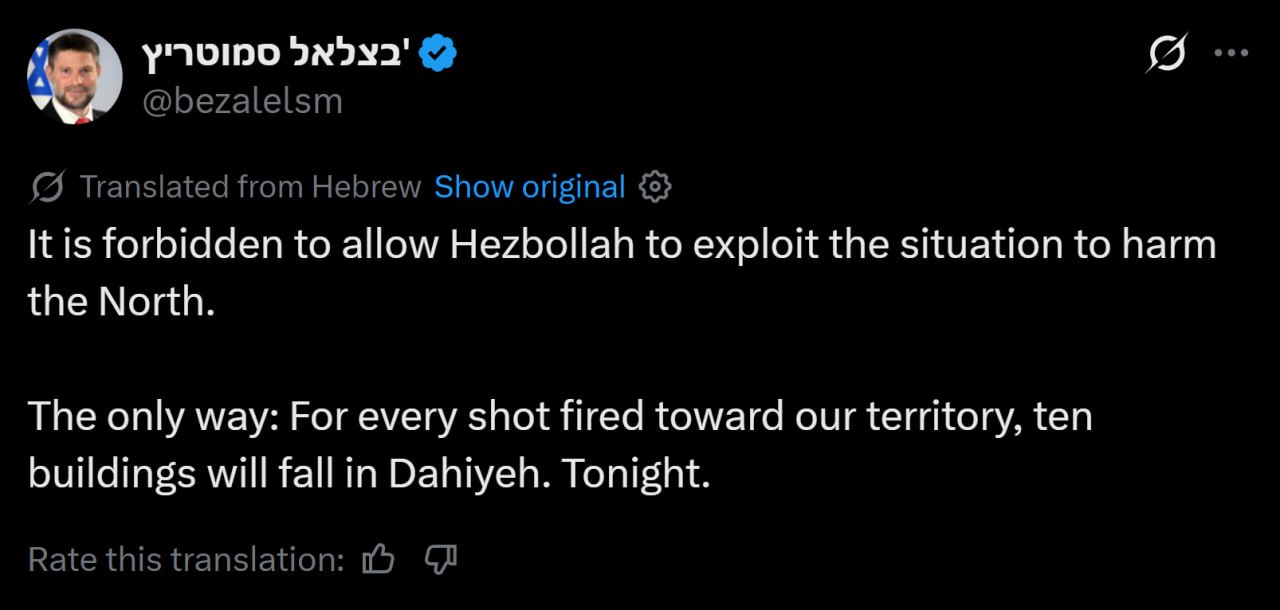
Dahiyeh is one of the most densely populated parts of Beirut. Ten buildings for one shot is not retaliation against a military target, it is a public commitment to collective punishment, posted by a sitting minister, on the eve of a deal Iran says ends the fighting on “all fronts, including Lebanon.” If carried out, it would not bend a deal that hasn’t been signed yet, it would detonate it before the signatures exist.
This is the same government whose defense minister has vowed not to leave Lebanon, whose security officials are telling Israeli media the withdrawal isn’t on the table, and whose senior officials are privately calling the whole thing a publicity exercise that won’t hold water.
Take Katz’s refusal, the IDF’s stated plan to keep the “security zone,” Smotrich’s ten-buildings threat, and that Ynet quote together, and nothing about Saturday night requires speculation to describe. Israel doesn’t want this deal. It has said so privately, implied it publicly, and has threatened collective punishment on a country Iran demands are part of the deal.
If this was worth reading to the end, it's worth sharing.