Iranian state media has published what it describes as the 14-point draft memorandum of understanding between the USA and Iran, hours after Donald Trump announced that a “great settlement” of the war had been reached and that strikes scheduled for Thursday evening had been cancelled. Tehran, for its part, says no final decision has been made.
Iran has so far denied the U.S. regime’s reports that an agreement has been reached, though it is not hiding that high level talks are taking place. Before we go any further, a warning: claims of an imminent deal have landed at the end of the week before, only for the USA to attack over the weekend that followed.
This war began that way. On Friday, February 27, Trump told reporters he was “not happy” with how Iran was negotiating, with further talks scheduled that same day. In the early hours of Saturday, February 28, the USA launched its strikes, claiming talks had broken down. Deal talk Friday, war Saturday.
It happened again two weeks ago. On Thursday, May 28, U.S. officials briefed that a tentative agreement had been reached to turn the ceasefire into a lasting settlement. On Friday, Trump sent back new demands on the Strait of Hormuz, Iran’s nuclear program, and frozen assets. Over the weekend, the USA and Iran exchanged military strikes, one week after Trump had declared the deal “largely finalized.”
And it nearly happened this week. The strikes Trump “cancelled” on Thursday evening would have been the third consecutive night of U.S. attacks on Iran, carried out on the very nights Washington was claiming a deal was at hand.
Three Fridays, three near-identical sequences. Two of those weekends ended in strikes. This one hasn't, yet
There is no deal. There are talks, there is a draft, and there is a president announcing victory; these are not the same thing. We’re going to walk through what’s actually on the table, who is claiming what, and why we’ll be treating one side’s account with considerably more weight than the other’s.
Mehr News, a semi-official Iranian outlet, published the claimed terms on Friday, citing a source close to Iran’s negotiating team. According to that report, the draft includes:
A permanent and immediate cessation of the war on all fronts, including Lebanon.A requirement that the USA and its allies present reconstruction plans for Iran worth at least $300 billion.A U.S. commitment not to interfere in Iran’s internal affairs and to respect the sovereignty of the Islamic Republic of Iran.Full lifting of the naval blockade within 30 days.A U.S. commitment to withdraw its forces from areas surrounding Iran.Reopening of the Strait of Hormuz within 30 days, under arrangements determined by Iran.Suspension of sanctions on the sale of oil, petrochemical products and related derivatives, with full Iranian access to the resulting financial revenues.A 60-day negotiation period aimed at reaching a final agreement covering nuclear issues and the complete removal of U.S. primary and secondary sanctions, as well as the repeal of relevant resolutions of the UN Security Council and the IAEA Board of Governors.Reaffirmation by Iran of its commitment under the Nuclear Non-Proliferation Treaty (NPT) not to produce nuclear weapons.During the negotiation period, a U.S. commitment not to deploy additional forces to the region and not to impose any new sanctions.The release of $24 billion in frozen Iranian assets during the 60-day final negotiation period, with half made available to Iran before negotiations begin.Establishment of a monitoring mechanism to oversee implementation of the agreement.Final negotiations not to begin before the release of half of Iran’s frozen assets, the suspension of oil sanctions, and the lifting of the naval blockade.The final agreement to focus exclusively on the future of enriched nuclear material and uranium enrichment, sanctions relief, and a program for rebuilding Iran’s economy, with Iran’s missile program and its support for resistance groups definitively excluded from the agenda.
These have been taken from Mehr’s report and corroborating coverage. While the U.S. President insists a deal has been either made or is imminent, depending on the hour and minute he happens to speak, the USA has crucially not released an overview of the “deal” he refers to.
These are, if accurate, sweeping terms. They would amount to the U.S. regime paying to end a war it started, and bowing to Iranian demands that they have repeatedly claimed would not be met. The Trump regime has since denied these are the terms of the deal, with Trump releasing a statement on his Truth Social platform.
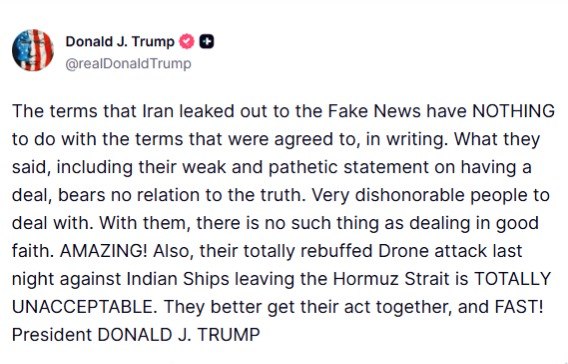
By Friday, the man who announced the settlement was disputing its published contents. "The terms that Iran leaked out to the Fake News have NOTHING to do with the terms that were agreed to, in writing," Trump posted, calling the Iranians "very dishonorable people to deal with" with whom "there is no such thing as dealing in good faith." Within twenty-four hours, the deal went from done to denied. The terms went from approved in "great detail" to bearing "no relation to the truth." Nothing about the war changed in those hours. Only the story did.
Trump’s Thursday announcement came on Truth Social: “Based on the fact that discussions with the Islamic Republic of Iran have been brought to the highest level of Iranian leadership and approved, I have, as President of the United States of America, cancelled the scheduled strikes and bombings against Iran this evening.”
He went on: “Discussions and final points have been, in both concept and great detail, approved by all parties involved, including the United States, Israel, Saudi Arabia, UAE, Qatar, Turkey, Pakistan, Bahrain, Kuwait, Jordan, Egypt, and others.”
Eleven countries named. Iran is not one of them. For a deal that is approved, it is bizarrely not approved by the party at the opposite end of the negotiating table.
This isn’t strange. It should be strange. CNN released a montage of 39 times the U.S. President has claimed a similar scenario, without a deal ever materialising.
In the Oval Office, Trump described “a great settlement of the war with Iran,” subject to “finalization of documents,” with a signing expected “over the next few days,” possibly in Europe over the weekend. Asked directly whether Supreme Leader Mojtaba Khamenei had approved the deal, his answer was: “I understand the answer is yes.”
Tehran’s account is very different. Foreign Ministry spokesman Esmaeil Baqaei said Iran “had not reached a final conclusion on the agreement,” and told IRNA that reports of a finalized deal were “merely speculation.” He added that most of the text had indeed been finalized, but that “the problem began when the US side made new demands and changed its positions.”
Iran’s Tasnim news agency noted that Trump had announced an imminent deal dozens times in the preceding two months, and advised that until Iran itself announces an understanding, anything Trump says on the subject should be regarded the same as his previous messaging.
We find ourselves in the unusual position of endorsing the editorial judgement of Tasnim.
On this specific question, who has accurately characterised the state of negotiations throughout this war, Tehran’s record is simply better than Washington’s. We have documented Iranian misstatements before and will again. But across more than three months of this conflict, it is the U.S. regime that has repeatedly announced deals that did not exist, ceasefires that did not hold, and approvals that had not been given. When the two accounts diverge, as they do now, we default to the party that has not made a habit of announcing fiction. Crust News will treat the terms of any deal as confirmed when Tehran confirms them, the only account in this war the USA has repeatedly corroborated after the fact.
Trump’s announcement landed Thursday evening. Markets immediately responded, with the S&P 500 jumping as much as 1.5% and oil prices sinking, before any document existed, before Iran had confirmed anything, before a signing date was set. Trump himself drew the connection between the announcement and the response of the markets, stating: “stock markets up 1,000 points; that means they like the deal.”
We’ve been hyper-aware of a pattern of late-week announcements from the USA, almost always announcements that do not bloom into reality. An announcement lands, markets surge on the headline, and the substance quietly fails to materialise. We had previously reported on the part played by the outlet Axios, who has been the source of many of these claims. The outlet told us that the reporter behind these claims “reflected the views” of Donald Trump, while refusing to guarantee any role facts played in the reports.
Whether this is deliberate market manipulation or simply a president who cannot resist declaring victory is, at some point, a distinction without a difference: people positioned ahead of these announcements profit either way, and the announcements keep coming regardless of whether the deals do.
It’s clear at this point that Trump’s deal announcements are not information about the war. They are information about Trump. The war’s actual state is better read from Tehran’s caveats, from the blockade that remains in force, and from the strikes that were “cancelled” Thursday only because they had been scheduled in the first place.
The draft terms published by Mehr broadly track what outlets have reported from sources close to the talks over recent weeks, which suggests the document is real and the negotiations are genuinely advanced. Iran’s own statements concede most of the text is finalized. A signing within days would be plausible if Donald Trump didn’t run straight to social media to deny these are the terms.
Even if we clear the hurdle of Donald Trump’s denial of the terms, plausible is not done deal. The U.S. side has, by Iran’s account, already changed its positions late in the process at least once. A claim that is backed up by Donald Trump publicly representing different terms at different points in time. For now, the blockade remains, the Strait of Hormuz remains closed, and a deal is not done. We can’t bring ourselves to follow other outlets in repeating the claims of a man who has failed to represent reality 39 times.
So we will report the signing when there is a signing, confirmed by the only party in this negotiation that has earned the presumption of accuracy. Until then, we are not taking the U.S. regime’s word for it, and nor should you.