Since the U.S.-Israeli attack on Iran in late February, launching a war that seems to have no end in sight, a pattern has repeated with enough regularity that we must address it. Axios publishes a report, citing anonymous U.S. officials, claiming a ceasefire or deal with Iran is imminent. Iranian officials deny it, sometimes within hours. The key part of this, is that each time, the financial markets move as a result of the latest Axios report. Weeks later, the cycle repeats.
The denial of Axios reports receives a fraction of the coverage in the wider media sphere, with mentions of the Iranian position almost always limited to Al Jazeera and independent outlets such as Crust News. Axios does not publish corrections when their reports are debunked by state actors, nor would they issue corrections in subsequent misreporting, even when the pattern of inaccurate reports had become clear. When we asked about this, Axios declined to address the question.
All four reports were written by the same reporter, Barak Ravid, an Israeli journalist who served approximately six years in the IDF, including in Unit 8200, the military's signals intelligence division, before a career in diplomatic journalism that brought him to Axios, where he covers the Middle East exclusively through the lens of U.S. and Israeli sources. Axios describes him as 'one of the most talented reporters of his generation,' working sources seven days a week.
Iran’s parliament speaker Mohammad-Bagher Ghalibaf addressed the clear pattern, calling the outlet’s inaccurate reporting “Operation Fauxios”, combining the outlet’s name with the French word for false.
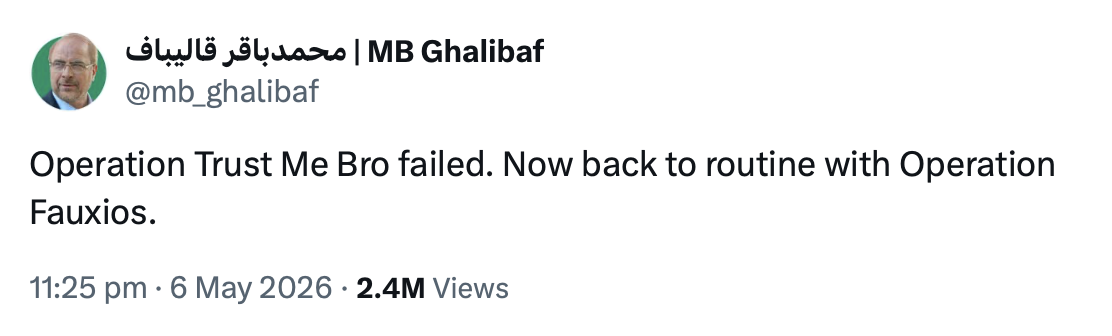
“Operation Trust Me Bro failed,” he posted on X in May. “Now back to routine with Operation Fauxios.” An Iranian foreign affairs committee spokesperson was blunter, calling the Axios reports “more of an American wish list than a reality.”
We are inclined to agree. Here is the documented record:
March 4. Axios reported that Iran had sent messages to the U.S. regime over the preceding days. Iran denied it the same day. “No message has been sent from Iran to the U.S., nor will any response be given to U.S. messages,” an Iranian official told Tasnim news agency. “Iran’s armed forces have prepared themselves for a long war.” A ceasefire did not arrive until five weeks after this report.
April 5. Axios reported that the U.S., Iran, and regional mediators were pushing for a 45-day ceasefire framework, citing four unnamed U.S., Israeli, and regional sources. Reuters said it could not verify the report. Iran rejected the framework. Market manipulation claims surfaced within 24 hours, with financial analysts publicly questioning the timing of trades placed ahead of the report’s market impact. Three days later, Pakistan brokered a peace plan on Iran’s terms, the terms outlined by Axios never appeared, leading to serious questions about the reliability of the source.
May 6-7. Axios reported the U.S. was close to a “one-page deal” with Iran, that Iran would respond within 48 hours, and that this was “the closest the two sides had come to a deal since the war began.” Iran denied it. Ghalibaf coined “Fauxios.” Trump then cited the Axios report to claim the U.S. had had “good talks over the last 24 hours”, using the report to validate his own claims, creating a closed loop in which Axios sourced U.S. officials and U.S. officials cited Axios. No deal followed this report.
May 28. Axios reported a 60-day memorandum of understanding had been reached. Markets rallied. Bloomberg confirmed the rally was driven by the report. Reuters confirmed an MOU existed but that Trump had not approved it, and noted, with admirable understatement, that the regime had “several times said a deal to end the fighting was close, only to have Iran dispute or downplay the claims.” The deal that had been “reached“ according to Axios is still yet to be signed at the time of publication.
In each case, the source was anonymous U.S. officials. In each case, Iran was not a confirming party. In each case, no correction followed the denial.
Anonymous sourcing exists in journalism to protect people who take personal risk to bring information to the public. It is not supposed to function as a frictionless pipeline for regime messaging, a mechanism by which officials who would be embarrassed to put their names to optimistic claims about stalled negotiations can nonetheless move markets with those claims, consequence-free, through a compliant outlet.
By the second report, the pattern was already visible. A source that had proven wrong once, on a claim with material market consequences, was being published again, this time claiming to have knowledge of the terms of the deal. Those terms never materialised in the deal that followed. That should have disqualified the source from further attribution. It did not.
When asked whether Axios has any policy on anonymous sourcing for market-sensitive reporting, the outlet's Director of Editorial Communications, Jake Wilkins, said only that Ravid is 'held to the same ethical standards as every reporter at Axios.' If the four inaccurate reports documented here are the standard, that answer raises serious questions about the standards held at Axios.
The question of who benefits is not difficult to answer. Every time Axios published, oil prices fell and equity markets rose on ceasefire optimism. The supposed source of the reporting and the political beneficiary of the market movement are the same entity, the Trump regime.
The Anti-Corruption Data Collective, a nonprofit research group, analysed all 435,672 markets settled on Polymarket between January 2021 and mid-March 2026, covering $54.4 billion in wagers. It found that longshot bets in military and defence markets win 51.8% of the time, against a 14% baseline across all categories.
Nine linked accounts were separately identified by blockchain analytics firm Bubblemaps as having generated $2.4 million from Iran war bets at a reported 98% win rate. Federal investigators are reviewing large oil futures trades placed on March 23, the morning traders put more than $800 million on declining oil prices minutes before Trump posted on Truth Social that Iran talks had been “very good and productive.” Oil fell more than 10%.
None of this proves Axios reporters knew their reporting was being used this way. What it does show is the real-world effects of reporting that proved false, regardless of intent. The fact that this was repeated again and again, by the same reporter, at the same outlet, is the central problem here. Four reports that shift the market, and no corrections from Axios, no accountability for the journalist who wrote each piece, and no attempt to incorporate the Iranian side in future claims.
What it looks like from here is an outlet that has allowed itself to become a vehicle for anonymous regime messaging, published without verification, with material consequences for global markets, and no mechanism for accountability when the claims prove false. Three times might be a pattern. A fourth is a choice. You don't need to believe there was coordination to see the problem.
Crust News put the following questions to Axios:
1. Does Axios have a comment on the pattern, and has the outlet taken any steps to address it?
2. Does Axios have any policy on the use of anonymous sourcing for reporting that is demonstrably market-sensitive, particularly where the named subject of the reporting is not a confirming party?
3. Has there been any internal review of the sourcing or editorial process behind these reports? Any repercussions for the reporter?
4. Will Axios continue to publish Barak Ravid’s reporting based on the same anonymous U.S. sources, given that those sources have provided claims Iran has publicly contradicted on at least four separate occasions, each time with measurable financial consequences?
5. In future reporting on Iran ceasefire or peace deal claims, will Axios commit to representing the Iranian position within the same piece, rather than leaving denial and contradiction to be reported elsewhere or not at all?
The response from Communications Director Jake Wilkins did not address a single one of our five questions:
Here’s our response to you:
- Barak Ravid is one of the most talented reporters of his generation, and has dominated the world’s most important story by working sources seven days a week for years.
- There’s a reason every newsroom in town is chasing and crediting his reporting every day: His reporting captures exactly what the president of the United States is thinking, saying privately, being advised and acting on, and how other nations are responding.
- Barak is also a great and generous colleague and human. We stand behind him and his reporting 1,000%.
- Regarding his use of unnamed sources, Barak is held to the same ethical standards as every reporter at Axios.