

U.S. Strikes Iran Over Helicopter Shot Down in Iranian-Omani Airspace

U.S. forces launched strikes against Iran in the last few moments. CENTCOM confirmed the launch of the attack moments after reports of explosions came out of Iran’s Mehr news agency. The U.S. military cite the downing of a U.S. Army AH-64 Apache helicopter over the Strait of Hormuz on Monday evening as justification.
Explosions have been reported in the Sirik port area, near Qeshm Island and Bandar Abbas, with Iranian air defence systems activated across the south. Israeli Channel 12 reports Trump briefed Netanyahu before the strikes began. Tomahawk cruise missiles were used, according to an Iranian outlet.
IRIB confirms six airstrikes on Qeshm Island alone. Targets confirmed so far include Sirik Naval Base, Jask Naval Base, the Bandar Abbas air defence position, Minab coastal missile battery, Qeshm coastal missile battery, and Qeshm Port. All strikes are concentrated in Hormozgan province along the Strait. Tasnim reports attacks on Jask and Kuh-e Mobarakeh. Mobarakeh Mountain in Hormozgan has also been struck, per local media.
U.S. bases in the region have been put on high alert for any Iranian response. Iran for its part has been insistent that any incoming attacks will be met with a strong response. Tasnim confirms Iran's position: the regime says it will give a definitive response to what it describes as U.S. aggression carried out under the pretext of the Apache crash.
This is happening just days after Israel triggered an exchange of fire with Iran. Israel bombed Beirut when Iran had explicitly warned them that any strike on the Lebanese capital would come with an immediate response.
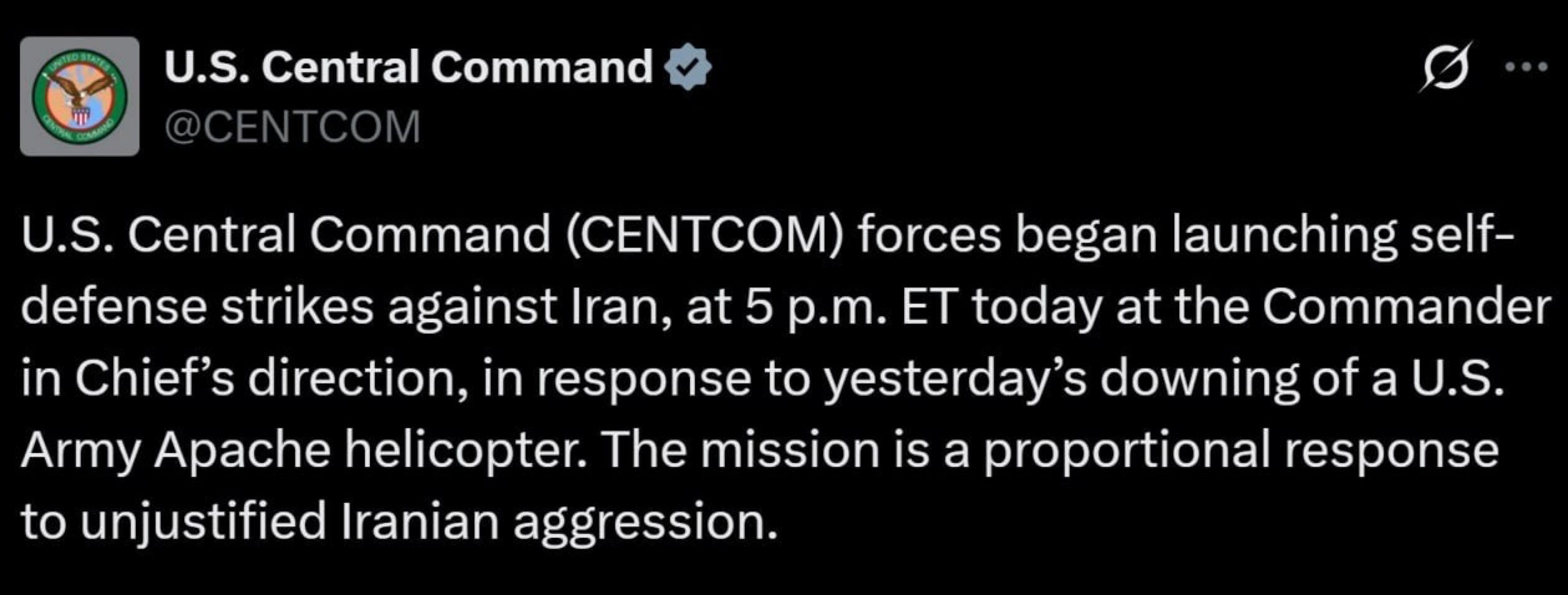
The pretext warrants heavy scrutiny. The U.S. investigation had not determined whether the downing was intentional at the time Trump announced a response. Even if “intentional”, the presence of a U.S. helicopter in shared Iranian-Omani airspace is the much larger question. International law is very clear on this, the USA has no right to fly within the airspace of other nations, they would need approval.
CENTCOM said the incident remains under investigation. Iran made no claim of responsibility. Iranian Foreign Minister Abbas Araghchi declined to mention any Iranian role, stating instead that foreign forces operating near Iranian territory carry inherent risk.
The Strait of Hormuz lies within Iranian and Omani territorial waters. The U.S. has no legal right to conduct military patrols there without the consent of the states who control the airspace. Iran, under international law, retains the right to respond to incursions into its airspace and territorial waters. An armed attack helicopter enforcing a blockade of Iranian ports is not a neutral vessel in innocent passage.
CENTCOM’s statement describes the strikes as “self-defense” and a “proportional response to unjustified Iranian aggression.” The aggression it describes took place inside Iranian sovereign space.
Iranian drones have been launched, with reported sightings over Baghdad and other areas of Iraq. Tasnim had previously noted that the Iranian military was waiting for the right conditions to launch an response to the attack.
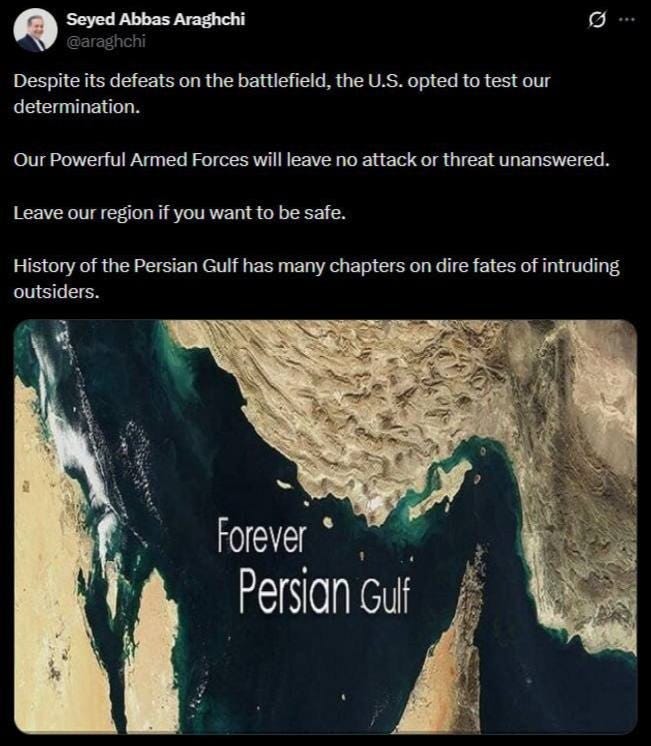
Iranian Foreign Minister Araghchi has responded directly to the strikes, warning that the regime's armed forces will leave no attack unanswered. 'Leave our region if you want to stay safe,' he wrote on X, adding that the history of the Persian Gulf 'contains many chapters detailing the tragic fate of foreign invaders.' He also noted that despite U.S. battlefield defeats, Washington had chosen to test Iran's resolve.
A local IRIB reporter on the ground in Sirik reports that U.S. strikes also hit water tanks in the area, cutting off the water supply to the district of Bamani.
A second wave of U.S. attacks on Iran is now underway, according to a senior U.S. official cited by Israeli Channel 12. Fresh explosions have been reported in Jask County, southern Iran, per Mehr News Agency. A strong explosion has also been reported in Nahavand city, per local sources. Nahavand is in Hamadan province, significantly further inland than the first wave's targets along the Strait.
A second wave of strikes sits uneasily with CENTCOM's framing of the operation as a proportional response to a single helicopter downing.
This is a developing story, we will update this piece as more news becomes available to us.